

Who is a Payments Product Manager?
Payments Manager OR Product Manager?

The payments product manager role has become very popular in recent years. Companies are starting to understand the value of investing into payments and having a dedicated payments person to own the payments product. However, there is no common understanding of how much this role is product versus payments.
Product Manager VS Payments Manager
When a business experiences a need with payments, they open it in the product department. In reality, this role is not only product. It oversees multiple domain areas such as compliance, vendor management, risks, business development, and many more.
I noticed that the role is very different depending if it is in enterprise company or a startup.
Payments PM role in large companies
Enterprises or companies operating with an Amazon-style working framework usually hire based on aligning with their values and work principles. They are less focused on domain expertise. It is more important for them to hire a person who will fit with their culture and will be a successful part of the team. In this case, the payments PM can even be without payments expertise and still be successful in the role.
During the interview, they will be asking how you solved problems in the past. They will not be asking about your knowledge of fraud, chargebacks, payment networks, etc.
The questions you get in the interview are product questions:
Tell me how you made a tradeoff
Tell me how you made a hard prioritization decision
Tell me how you disagreed with a leader
However, this may really differ from what a typical payments PM does in real life.
Payments PM role in startups
In smaller companies, the payments product manager is usually a payments expert. It happens that this person also manages the payments team and the roadmap. In this case, the payments PM also owns payments compliance, authorization rate metrics, payments analysis, risks, onboarding, vendor relationships, and many more.
What are the payments PM skills?
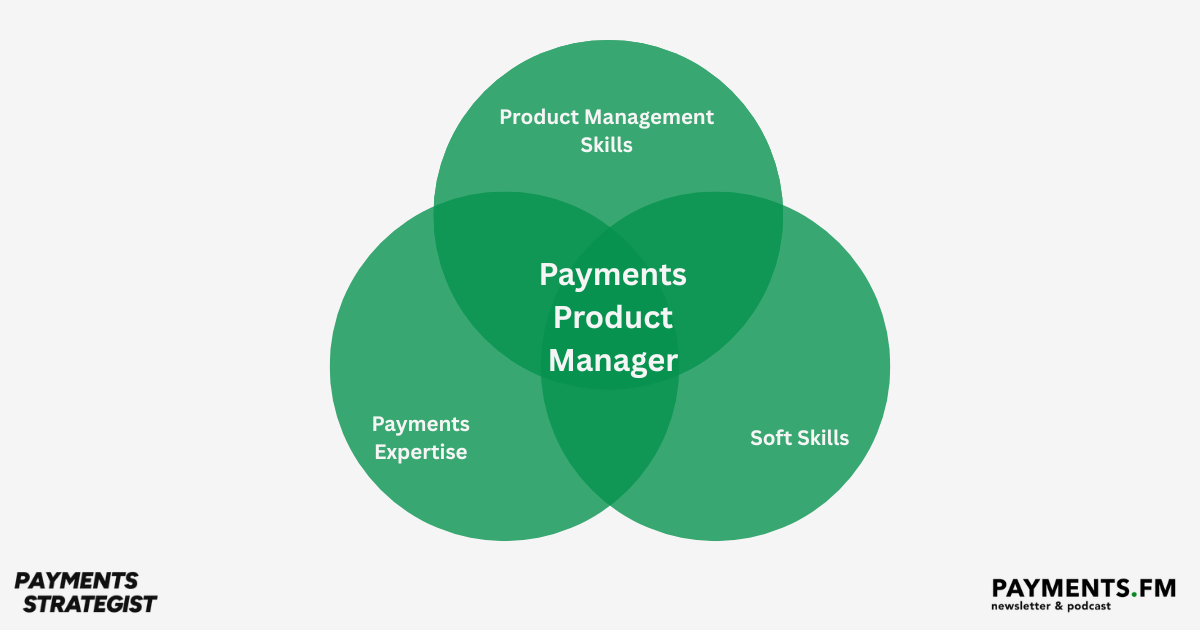
Regardless of the approach, the payments product manager is a combination of payments and product management skills.
As a payments PM, you should be a very strong PM, and here is why:
Stakeholder manager. As a payments PM, you need to work with a lot of stakeholders and strong leaders. Internal stakeholders include risks, compliance, accounting, revenue, and finance teams. So your stakeholder management should be top notch.
Defending your strategy. Because everybody has an opinion on payments. Sometimes the company CEO brings ideas to the table. A strong PM can’t be reactive to every new insight and should have a strong, defensible strategy.
Data driven. Payments have a lot of data. A payments PM should understand what the key challenges are and how certain payment metrics affect business KPIs.
Business oriented. Payments directly affect business revenue. A payments PM should be able to create a business case and understand the impact of opportunities.
Payments expertise
Depending on the business model, the payments expertise required and the level of depth can be quite different. Let me outline some key areas that are usually required:
Transaction lifecycle. Understanding how a payment moves from authorization to capture, refund, and payout and what can go wrong at each step.
Payments compliance. Navigating requirements like PCI DSS, SCA, and regional regulations that directly shape what you can and cannot build.
Vendor management. Evaluating, integrating, and maintaining relationships with payment providers, including commercial negotiations and technical partnerships.
Payments metrics and analysis. Tracking authorization rates, decline reasons, chargebacks rate, and cost per transaction to identify optimization opportunities and measure business impact.
Fraud and risk management. Balancing fraud prevention with customer experience, knowing that every friction point you add to stop bad actors also affects good ones.
Soft skills
Payments PMs are often ICs, which means they don’t have direct authority over the teams they depend on. They need to be able to lead through influence and aligning stakeholders around a shared priority without owning the reporting line.
Payments work items are usually quite complex and span multiple systems. Being able to effectively partner with engineering for understanding technical constraints, speaking their language, and earning their trust is key to delivering reliably.
Bottom line
The payments PM role is quite interesting and challenging at the same time. To be successful in this role you need to excel in both product skills and payments knowledge. However, what will be a balance of one or another will depend on where you work.
If you liked this article you also may be interested in
Payments Education
We have some spots left in our payments courses. Go to the courses page and reserve a spot. We will contact you with a schedule a pricing options.
Payments Interviews
Here are some great interviews we host on Payments.FM